|
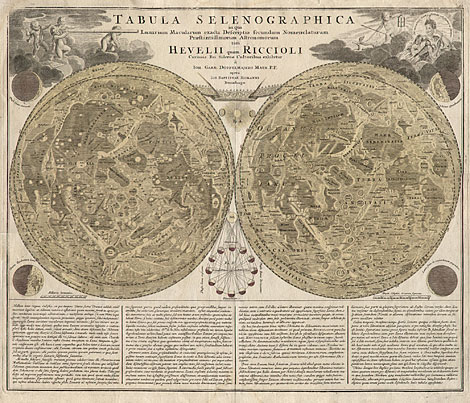
Map of the Moon
"Tabula Selenographica in qua Lunarium Macularum
exacta Descriptio secundum Nomenclaturam Praestantissimorum
Astronomorum tam Hevelii quam Riccioli Curiosis
Rei Sidereae Cultoribus exhibetur a Ioh. Gabr. Doppelmajero
Math. P.P. opera Ioh. Baptistae Homanni Norimbergae."
Originally coloured copper engraving, by Johann
Gabriel Doppelmayr, published by Homann Heirs, Nuremberg
1712-42. 49,5 x 59 cm.
Very good impression and condition.
€ 725,-
|
| Map of the moon in two hemispheres after the
lunar map by the astronomer Johannes Hevelius (1611-1687),
published 1647, and after informations of the astronomer
Giovanni Battista Riccioli (1598-1671). With the
phases of the moon, a title cartouche in the upper
part, surrounded by putti on clouds and with Diana,
the Roman goddess of the moon and the hunt. Below
is a text with full explanations about the moon.
Johann Gabriel Doppelmayr (1677-1750)
Doppelmayr was the son of a merchant in Nuremberg.
First he studied law in Altdorf nearby Nuremberg
and later on mathematics and astronomy in Halle
/ Saale. 1704 he became professor for mathematics
and 1716 director of the Eimmart observatory in
Nuremberg. Even during this time (latest from 1706)
he worked for Johann Baptist Homann and his publishing
house. 1714 his introduction on geography for the
large Homann atlas was published. 1742 his 'Atlas
Coelestis' with 30 celestial maps was published
by Homann Heirs. Together with the engraver Johann
Georg Puschner the Elder (1680-1749) he made several
terrestrial and celestial globes. Through his work
the heliocentrism by Copernicus became much more
popular.
Ref.: John Goss. Kartenkunst. Die Geschichte
der Kartographie. Braunschweig 1994, plate 10.12.,
pp 313/314.
Friedrich von Hagen. Nürnberger Verleger
kartographischer Produkte vom späten 17. bis
zur Mitte des 19. Jahrhunderts.
In: "auserlesene
und allerneueste Landkarten", Stadtarchiv Nürnberg,
catalogue 14, 2002, p 55/56.
|