|
|
|
|
Giovanni
Battista Piranesi
1720
Mogliano Veneto
– Rome 1778
|
Venice:
The first 20 years, 1720 -
1740
G.B. Piranesi
was born October
4th, 1720 in
Mogliano nearby
Mestre as the
son of a stonemason.
He was trained
in architecture
at the 'Magistrato
delle Acque'
in Venice. His
brother Angelo,
a Carthusian
monk, teached
him Roman history
and the Latin
language.
First he
came to Rome,
1740-44, as
a draughtsman
with the entourage
of Marco Foscarini,
a historiograph
of the Republic
of Venice and
ambassador at
the Holy See.
After a short
stay in Venice,
1744, he came
back to Rome
1745, this time
as an assistant
of the engraver
and publisher
Giuseppe Wagner,
and he founded
his own studio
in the Via del
Corso, vis-à-vis
of the Palazzo
Moncini - seat
of the French
Academy in Rome.
|
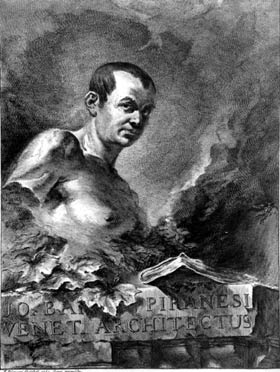
Felice
Polanzani: Portrait of
Giovanni Battista Piranesi
1750
|
| 
|
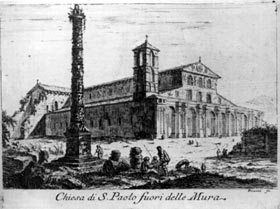
Varie
Vedute: S. Paolo fuori le
Mura
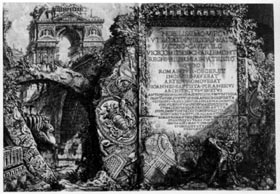
Antichita Romane: Frontispiece
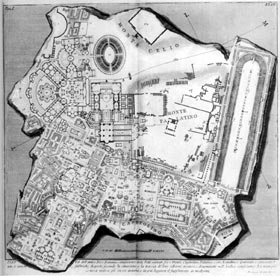
Antichità
Romane: Forum Romanum
|
Rome:
The
first series
of etchings,
1745-61
1748 the
first edition
of his 'Archi
Trionfali' was
published under
the title 'Antichità
Romane de' Tempi
della Repubblica
e de' Primi
Imperatori',
1765 re-edited
as 'Alcune Vedute
di Archi Trionfali'.
The 30 views
of ancient buildings
in Italy and
Rome were made
after sketches
he did during
his journey
around Italy
1743-45, when
he visited Pola,
Verona, Rimini,
and Ancona.
For the next
generation of
his views he
chose a larger
size. In his
series 'Vedute
di Roma', for
which he made
135 plates in
30 years, he
uniquely records
the significance
of the buildings
of the ancient
and baroque
world in and
around Rome.
The etchings
and copper engravings
of the 'Vedute
di Roma' are
a central but
only small part
of his complete
work, which
consists of
more than one
thousand single
etchings. 1751
Giovanni Jean
Bouchard published
the first 34
views of this
series under
the title 'Le
Magnificenze
di Roma'.
1752 Piranesi
married Angela
Pasquini. Their
daughter Laura
was born 1755,
and the eldest
son Francesco
1758/59.
1756 Piranesi
published, to
help to rescue
the ancient
buildings of
Rome, the 'Antichità
Romane', which
founded his
international
reputation as
an archaeologist.
1757 he became
a member of
the 'London
Society of Antiquaries'.
After that he
was busy with
making some
more etchings
for his 'Vedute
di Roma', which
were published
by Bouchard
& Gravier
from 1756 till
1761.
|
|
|
Rome:
At
the hight of
his fame, 1761-69
Piranesi
now has reached
the hight of
his fame. He
became a member
of the Roman
academy S. Lucia
and his success
in business,
supported by
pope Clemens
XIII - who came
from Venice
and admired
very much Piranesi's
works of art,
enabled him
to establish
his own publishing
house. 1761
he moved with
his family and
his studio into
the Palazzo
Tomati, at the
Via Sistina,
under which
name he traded
from now on.
One of the first
plates with
the new address
'presso l'autore
nel Palazzo
Tomati' was
his famous view
of the Pantheon
(Hind 60).
In the same
year he re-issued
his 'Carceri'
and for the
first time he
published a
detailed and
complete catalogue
of his etchings,
which also contains
the first 59
views of the
'Vedute di Roma'.
Piranesi
continued to
study the ancient
Roman and Etruscan
buildings, the
Roman water
supply system
or the water
level regulation
system of the
Alban Lake and
he made many
excursions to
the Roman Campagna.
The results
of his studies
he published
in his works
of art as the
'Della Magnificenza
ed Architettura
de' Romani'
and the 'Campus
Martius' (1761/62).
His etchings
of the 'Antichità
d'Albano e di
Castel Gandolfo',
which were published
1764, he made
by order of
the pope. 1765
he re-edited
the 'Archi Trionfali'.
1765 Piranesi
obtained two
contracts as
an architect:
First to finish
the rebuilding
of the nave
of the Basilica
of St John Lateran
and second to
convert the
church S. Maria
del Priorato
on the Aventine
Hill.
1766 Piranesi
got the order
of the golden
spur by pope
Clemens XIII
and from that
time on he mostly
signed his etchings
with 'Cavalier
Piranesi F.'.
|
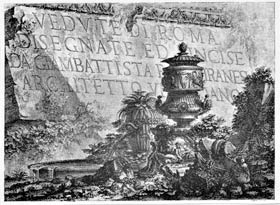
Title of the Vedute di Roma
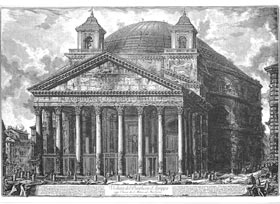
Vedute
di Roma: The Pantheon
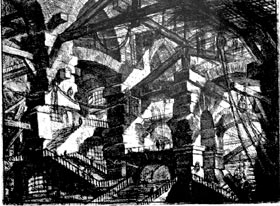
Carceri:
plate XIV, 2. state |
|
|
| 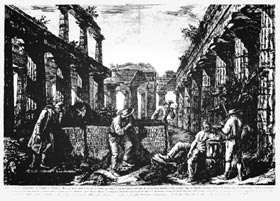
Temples of Paestum: Frontispiece 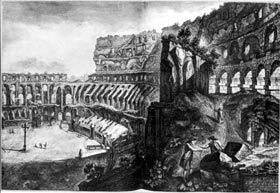
Colosseum by Francesco Piranesi |
Rome:
The
later years,
1770-78
During the
sixties and
seventies the
number of the
customers, who
collected his
etchings, grew
up continuously
all over Europe.
For his 'Vedute
di Roma' he
made about 40
new etchings
during this
time.
Piranesi's
last great series
of views dealt
with the Greek
temples at Paestum.
1777/78 he went
there together
with his son
Francesco and
Benetto Moris,
the specialist
for architecture
in his company,
to make drawings
of all three
temples of Paestum.
Even in the
same year a
series of 20
views was made,
finished and
published by
Francesco Piranesi
1779.
G.B. Piranesi
died November
9, 1778 and
was buried at
S. Maria del
Priorato. The
statue on his
grave was made
by Giuseppe
Angelini and
shows Piranesi
in an ancient
dress holding
the signs of
an architekt
and graphic
artist.
|
|
|
Literature
Brettagno,
A. (ed.): "Piranesi:
Incisioni -
Rami - Legature
- Architetture",
Neri Pozza,
Venice 1978.
Fiacci, L.:
"Giovanni
Battista Piranesi:
The Complete
Etchings",
Taschen 2000.
Focillon,
H.: "Giovanni
Battista Piranesi,
1720 - 1778",
Paris 1918.
Giesecke,
A.: "Giovanni
Battista Piranesi",
Meister der
Graphik, vol.
IV, Leipzig
1911.
Hind, A.
"Giovanni
Battista Piranesi:
A Critical Study
with a List
of the Published
Works",
The Holland
Press, London,
1922.
Robinson,
A.: "The
'Veduti di Roma'
of Giovanni
Battista Piranesi:
Notes towards
a revision of
Hind's catalogue",
Nouvelles de
l'estampe, No
4, 1970.
Wilton-Ely,
J.: "Giovanni
Battista Piranesi:
Vision und Werk",
Hirmer Verlag,
Munich 1978.
Back
to top
|
|
|
|


