Catalogue
All
entries are original tinted
lithographs after the drawings
of David Roberts (R.A.) worked
out by H. Haghe and published
by E.G. Moon, London 1842 -
1849. Catalogue numbers are
in chronological order following
the itinerary of David Roberts
(1838/39).
All
offered items are from the First
or the Deluxe Edition (both
1842 - 1849). Half-page plate
prints of the First Edition
are full page items with the
text beneath the image and on
verso. Prints of the Deluxe
Edition are coloured and finished
by hand, trimmed to the image
and mounted to a backing board
without text.
All
prints are in a very good condition,
except as noted. Entries give,
after the catalogue number and
a short description, Roberts'
inscription from the plate surface,
the title, edition, size (height
x width), and condition, followed
by a few additional information
about the picture.
All
prices are given in EURO. Errors
excepted.
Lithographs
by David
Roberts you will
find under views
of
Africa / Egypt
and views
of
Asia / Middle
East.
|
David
Roberts, R.A.
(1796
- 1864
Youth
and apprenticeship
David
Roberts was born the son of
a shoemaker at Stockebridge,
near Edinburgh, on October 24,
1796. Encouraged by his family
he started very early - already
as a boy - to describe and depict
his surroundings, especially
the castles und ruins at the
countryside of his hometown.
At the age of 11 or 12 he started
a seven-year apprenticeship
with a local decorator, from
whom he learned some of the
basic techniques in painting.
But
he learned mostly by spending
all his free time sketching
and painting. In general we
can say he remained all his
life a remarkable gifted self-educated
artist.
In 1815-16
he started work as an assistant
set designer in a small theatre
in Edinburgh. A few years later
he became the official painter
of the Royal Theatre in Glasgow
and somewhat later in Edinburgh.
Starting
his career
Already
by that time he became increasingly
famous and in 1821 he received
an offer to work for the Drury
Lane Theatre in London, and
two years later for the Covent
Garden opera house.
About
1826 he published his ,View
of the Cathedral of Rouen',
which was shown at the Royal
Academy and highly praised by
the critics. After that he received
more and more response from
private clients and in 1830
he decided to give up his work
as a set designer to start a
career as a studio painter.
In 1831 he was elected chairman
of the Society of British Artists.
Travelling
in Europe
From
1831 on he began to travel in
Europe. First he visited France,
in 1832/33 he spent nearly two
years in Spain, at that time
a little known country, sketching
buildings, monuments and ruins
from a wide variety of periods. |
From
all his travels - also in Germany
and the Netherlands - he brought
back a great number of sketches,
which served as a basis for
many publications, e.g. ,Pilgrims
of the Rhine' or ,Picturesque
Sketches of Spain'.
So he
gained a greater reputation
as a gallery painter and his
increased awareness of different
landscapes and architectural
styles played a major role in
the success of his paintings.
Travels
through Egypt
Roberts
left London for the Near East
in August 1838. At the end of
September he arrived in Alexandria
(No. 1). Here he met the consul,
Robert Thornburn, well known
to British travellers of the
period because of his unrivalled
helpfulness. On September 27,
Roberts started to Cairo (No.
2), where he arrived on Sept.
30. In Cairo he stayed for a
week for travel preparations
and he had only time for one
sketch (No. 3). He hired a boat
and finally he embarked on October
6 with a crew of eight men -
plus his personal servant -
to sail up the Nile as far as
Nubia and Abu Simbel.
Roberts
was deeply impressed by the
country, especially the riverside
temples and all the archaeological
sites in the region, although
much was still unexcavated and
the major temples were still
buried under piles of sand.
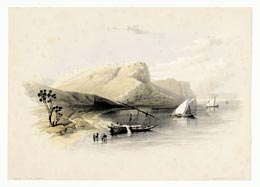
Item
No. 06
The Fortress
of Ibrim
During
the quite arduous voyage up
the Nile he only made a dozen
sketches. On Friday, November
9, 1838, they reached Abu Simbel
and Roberts described it as
"the monument which alone
makes the trip to Nubia worthwhile".
The other members of the expedition
continued as far as Wadi Halfa
to see the Second Cataract,
while Roberts decided to work
on some drawings. |


