From
Nazareth (No. 51) they went
to Cana of Galilee and the Sea
of Galilee (Tiberias). "April
21, Sunday: Passing on through
a beautiful country. we came
in sight of the Sea of Galilee.
Far to the left is Mount Hermon,
and near to us Safed.".
From there they went westward
to Haifa and the Mount Carmel
and then they followed the coastline
to the north via Tyre (Sur,
No. 52) to Sidon (No. 53 - 55), the
ancient and most important Phoenician
ports.
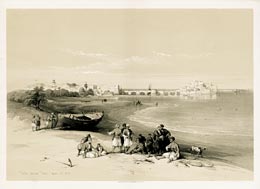
Item No.
55
View of Sidon
During
the first days of May they arrived
at Baalbec, the ancient Heliopolis.
Because of an incipient fever,
Roberts had to stay the first
day in bed. But nevertheless,
even the next day he started
work again. During the following
week he stayed in Baalbec and
drew half a dozen sketches (No.
56 - 59). Among them are his
finest pieces of work. He was
elected as a member of the Royal
Academy (R.A.) as a result of
his oil-on-canvas painting "Doorway
of the Temple of Bacchus".
This painting was an elaboration
of the sketch he did in Baalbec,
completed later at his home
in London.
On the
13 of May he boarded a ship
bound for Alexandria, where
he arrived after a voyage of
three days. About one week later
he embarked for England, where
he arrived at the 21 of July,
1839.
The
publication of the lithographs
Back
again in London, he submitted
the results of his journey,
272 sketches, a panorama of
Cairo and three full sketchbooks,
to numerous publishers. He received
the right kind of interest from
Francis Graham Moon, who
offered him three thousand pounds
to publish the work.
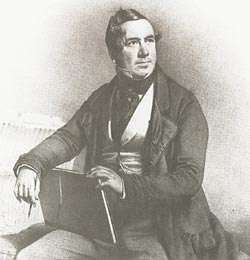
David
Roberts, R. A.
(1796 - 1864) |
The
lithographs were produced by
Louis Haghe on the basis of
Roberts' own drawings and comments.
The production of the prints
involved over 600 lithographic
stones. M. Tayman wrote: "Roberts'
Holy Land and Egypt project
is the most ambitious work ever
published in England with lithographic
plates."
For
the lithographic process various
techniques were used by L. Haghe
and his assistants to achieve
numerous tonal effects. The
lithographs were printed with
1, 2 or 3 tints.
The
prints were published by F.G.
Moon. London, between 1842 and
1849 and issued in six volumes
with all 247 prints. The text
for the ,Holy Land' series was
written by Rev. George Croly
and by William Brockedon for
the ,Egypt and Nubia' series.
In a Subscription or Deluxe
Edition, published at the same
time of the First Edition, the
prints were presented like watercolours.
They were coloured and finished
by hand, trimmed to the image
and mounted to a backing board
without text.
Two
years after Roberts came back
home to London he became a full
member of the Royal Academy
(R.A.). Now he started again
to visit many countries in Europe
and during the next decades
he had great success, in Britain
and abroad, with his paintings
and engravings in leading galleries,
for which he received many prizes
and awards. His huge clientele,
as well as his friends, included
many of the leading personalities
of this time, such as Charles
Dickens, William Turner or William
Thackeray.
David
Roberts died at the age of 68
on November 25, 1864, and was
buried in Norwood cemetery.
His private collection of his
own sketches, drawings and prints
was auctioned one year later
by Christie's and spread all
over the world. Most of his
oil paintings are exhibited
in leading English and Scottish
museums.
|


