Travels
through the Holy Land
On February
7 he started the second part
of his journey through the Near
East. He left Cairo for the
Holy Land in company with 15
Arab guards and 21 camels.
First
they went via Suez to the Mount
Sinai. Here they stayed from
February 18 to 23 at the Monastery
of St. Catherine (No. 31). Next
they travelled along the Gulf
of Aqaba (No. 32) to Petra and
the Mount Hor. They reached
this area on March 6, and Roberts
painted all the historical sites
around during the next five
days (No. 33 - 38).
Petra proved for Roberts a theatrical
wonder, and, as he wrote in
his diary "probably one
of the greatest challenges on
earth to a painter".
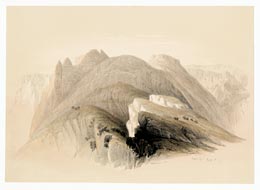
Item
No. 34
Mount
Hor, from the cliffs surrounding
Petra
Leaving
this area on March 11 they first
passed Wadi Arabah (No. 39)
and the Ruins of Semua (No.
40) on their way to Hebron.
Before going to Jerusalem they
made quite a detour via Beth
Gebrin, the ancient Eleutheropolis
(No. 41), Gaza, Askelon, Ashdod,
Jaffa, and Lod, in order not
to miss any of these important
historical points of interest.
On March
29 , a Good Friday, they arrived
in Jerusalem. Roberts wrote
in his diary: "I made the
circuit of the city walls, proceeding
northward by the gate of Damascus
and the Valley Jehoshaphat to
the hill of Sion, where the
tomb of David is placed.".
|
During
his first days in the town he
only drew a few pictures (No.
42, 43) and after three days
he decided to make a roundtrip
for a week to visit Jericho
(No. 44), the river Jordan,
and the Dead Sea (No. 45, 46).
He returned via the Monastery
of St. Saba and Bethlehem
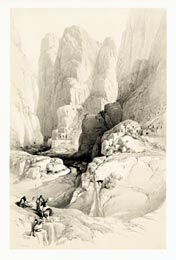
Item
No. 35
The
Entrance to Petra - The Theatre
to Jerusalem,
where he stayed for another
week to make more sketches and
drawings (No. 47, 48).
The
third part of his journey through
the Holy Land led him to the
Northern part of the country,
from Jerusalem to Baalbec. He
started on April 15 to Nablus
making some pictures during
the next two days (No. 49).
From there Roberts and his travelling
companions followed a track
to Nazareth, on which they passed
the very imposing Mount Tabor
(No. 50).
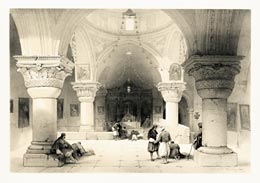
Item
No. 48
The
Chapel of St. Helena
|


